
Raising funding is one of the biggest challenges for startups in India. Many founders often get confused between angel investors and venture capital funding while planning their startup growth. Both funding options help startups raise capital, but they work differently and are suitable for different business stages.
In this guide, we explain the difference between angel investors vs venture capital, their advantages, and which option is better for startups in India.
What Are Angel Investors?
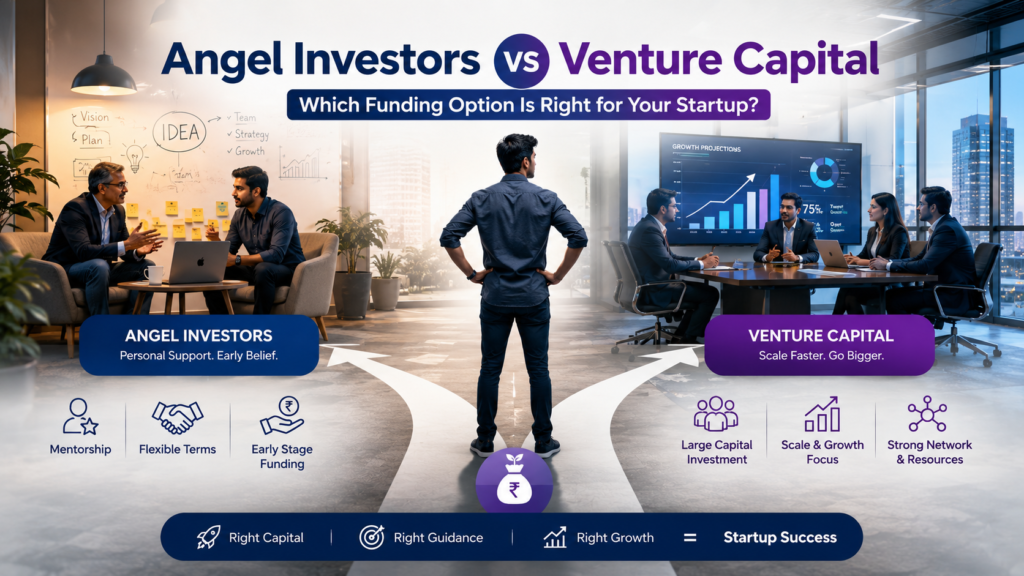
Angel investors are individuals who invest their personal money into early-stage startups in exchange for equity. They usually support startups during the idea or beginning stage when businesses need initial capital.
Apart from funding, angel investors also provide:
- mentorship
- industry connections
- business guidance
- networking opportunities
Many founders looking for startup funding in India start by approaching angel investors because they are more flexible and founder-friendly.
Read more: angel investors in Noida
What is Venture Capital?
Venture capital (VC) refers to professional investment firms that invest in startups with high growth potential. Unlike angel investors, VC firms usually invest larger amounts and focus on startups that already have traction, users, or revenue.
Venture capital funding is commonly used for:
- scaling operations
- expanding into new markets
- hiring teams
- product development
Today, many startups seek venture capital funding in India after validating their business model.
Key Difference Between Angel Investors and Venture Capital
| Factor | Angel Investors | Venture Capital |
| Investment Stage | Early-stage startups | Growth-stage startups |
| Investment Amount | Smaller funding | Larger funding |
| Decision Process | Faster | More structured |
| Risk Appetite | Higher | Moderate |
| Mentorship | Personal guidance | Strategic business scaling |
| Equity Expectations | Flexible | Higher ownership expectations |
When Should Startups Choose Angel Investors?
Angel investors are usually the best option for startups that are:
- at the idea stage
- building MVPs
- launching their first product
- testing market demand
They are suitable for founders who need initial support and mentorship.
Benefits of Angel Investors
✔ Easier Access to Funding
Angel investors are generally more open to funding innovative startup ideas.
✔ Faster Decision Making
Funding approvals are often quicker compared to venture capital firms.
✔ Mentorship & Networking
Many angel investors help founders with business strategy and industry connections.
For startups seeking early-stage startup funding in India, angel investors are often the ideal starting point.
When Should Startups Choose Venture Capital?
Venture capital funding is suitable for startups that already have:
- product-market fit
- customer traction
- revenue growth
- scalability potential
VC firms invest in businesses capable of generating large returns.
Benefits of Venture Capital Funding
✔ Large Investment Amounts
VC firms provide higher funding compared to angel investors.
✔ Faster Business Scaling
Startups can expand operations, marketing, and teams more aggressively.
✔ Strong Industry Network
VC firms help startups connect with strategic partners and future investors.
If your startup is ready for growth and expansion, VC funding for startups can be a strong option.
Which is Better for Startups in India?
The answer depends on your startup stage and business goals.
Choose Angel Investors If:
- You are in the early stage
- You need mentorship
- You are validating your startup idea
- You need smaller funding amounts
Choose Venture Capital If:
- Your startup is growing rapidly
- You already have traction
- You need large-scale funding
- You want aggressive expansion
Many successful startups first raise angel funding and later move toward venture capital funding as they grow.
How to Prepare Before Approaching Investors
Whether you approach angel investors or venture capital firms, preparation is critical.
Build a Strong Pitch Deck
Your pitch should clearly explain:
- problem and solution
- market opportunity
- business model
- growth plan
- funding requirement
Validate Your Business Model
Investors prefer startups with clear scalability and market demand.
Research the Right Investors
Always approach investors who align with your industry and startup stage.
Submit your startup pitch here: submit-a-pitch
Common Mistakes Founders Should Avoid
Many startups fail to secure funding because of:
- weak pitch decks
- unclear revenue strategy
- unrealistic valuation
- lack of preparation
- targeting wrong investors
Avoiding these mistakes improves your chances of raising startup funding in India successfully.
Why Choose Early Startups
Early Startups is a growing startup funding platform in India that helps founders connect with investors, mentors, and funding opportunities. Based in Noida, the platform supports startups with strategic guidance and investor access.
Whether you are looking for startup funding in Noida or planning to scale your startup across India, Early Startups helps founders connect with the right investors and funding networks.
Final Thoughts
Both angel investors and venture capital firms play an important role in the startup ecosystem. Angel investors help startups during the early stages, while venture capital firms support scaling and expansion.
Choosing the right funding option depends on your startup’s stage, goals, and funding requirements. By understanding the difference between angel investors vs venture capital, founders can make smarter funding decisions and grow their startups successfully.